
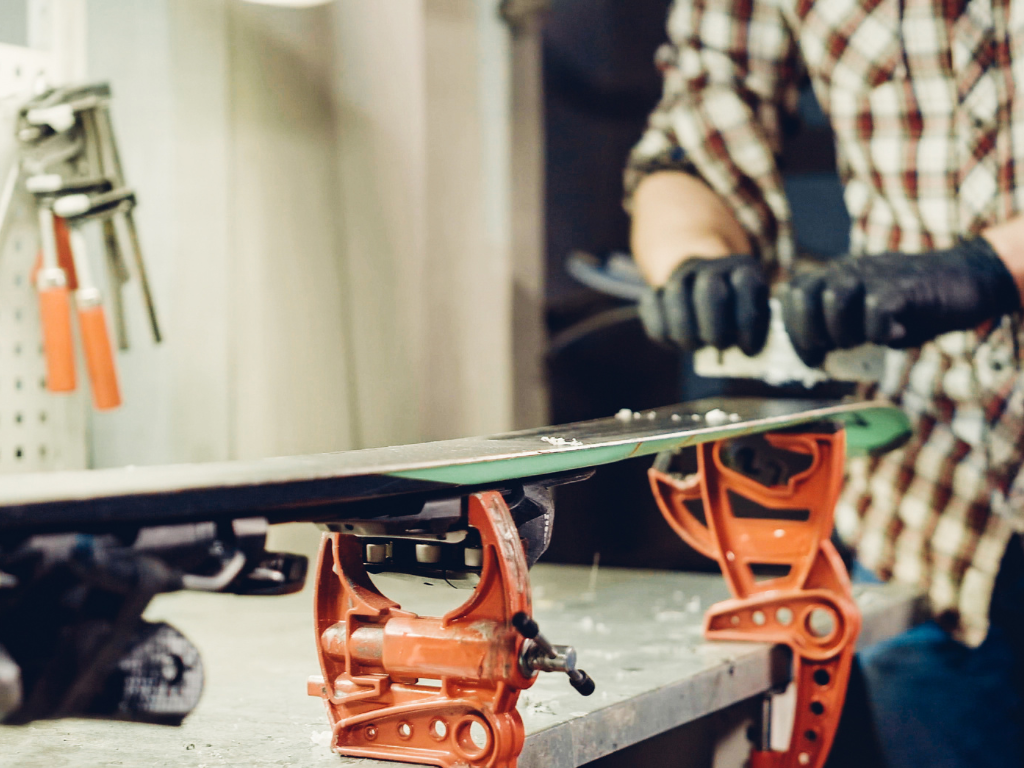


Most people wait until something feels obviously wrong before getting their gear serviced. The problem is that by the time it feels bad, the damage is often already done. Dull edges, dry bases, and deep gouges don't just affect performance, they get worse with every run and can shorten the life of your gear significantly. Here's what to look and feel for, and when to act on it.

Signs Your Skis or Snowboard Need a Tune (Before You Damage Them)
Your Edges Feel Slippery on Hard Snow
This is the most common sign, and the one people most often chalk up to "just icy conditions." If you're losing grip when you try to hold a traverse, sliding out on turns you'd normally nail, or feeling like your edges are skating rather than biting, your edges are dull.
The fingernail test is the quickest check: run your fingernail across the edge at a right angle to the ski. A sharp edge will catch and scrape a little. A dull one will let your nail glide straight over it. If it's the latter, you need an edge tune.
Technically, edges dull through a combination of micro-burring from contact with hard snow and ice, and rounding of the edge geometry over time. A properly tuned edge has a clean, consistent bevel angle. Once that angle is gone, no amount of waxing will restore grip.
Your Skis or Board Feels Slow Even on Fresh Snow
If you're getting overtaken on a groomed run by people with no apparent reason to be faster, the base is likely the culprit. A dry base that hasn't been waxed recently creates friction against the snow rather than gliding over it. Look at the base under good light, if it looks white or chalky in patches rather than a consistent dark colour, it needs wax.
For snowboards this is particularly noticeable on flat sections and run-outs, where a well-waxed board carries speed and a dry one dies. If you're regularly having to unstrap and walk sections that others are riding through, wax is almost certainly the issue.
You Can See or Feel Gouges in the Base
Run your finger along the base. Small scratches are normal wear and can be addressed with a wax. Deeper gouges, ones you can feel with your fingernail or see clearly, are a different matter. Left untreated, they expose the base material to further damage and can affect the flatness of the base, which in turn affects edge performance.
Base gouges should be repaired with a P-tex candle or, for anything significant, a professional base weld at a workshop. If a gouge runs into or along an edge, get it looked at by a technician, as edge integrity may be compromised.
Your Edges Have Visible Rust or Burrs
Pull your ski or board out of storage, or take a close look after a day on wet spring snow, and check the edges. Surface rust appears as a brownish discolouration along the metal edge. Light rust can be removed with a gummy stone or fine diamond stone at home. Heavy rust, or rust that has pitted the edge surface, needs professional attention.
Burrs are small raised pieces of metal on the edge, often caused by rock strikes or rail contact on a snowboard. Run your fingernail along the flat face of the edge (not across it). If you feel jagged or rough spots, those are burrs and they need to be filed out. A burred edge catches unpredictably and can actually be more dangerous than a simply dull one.
Your Board's Base Isn't Flat
This one is harder to self-diagnose but worth knowing about. Place a metal ruler or a flat tool across the base of your snowboard. A healthy base should sit flush. If the edges are higher than the centre (known as a railed base) you'll feel sluggish edge-to-edge transitions and reduced control. If the centre is higher than the edges (a rockered or dished base), you'll experience unpredictable catching and difficulty holding an edge.
Both issues require a stone grind to correct and can't be fixed with waxing or edge filing alone. Skis can develop the same problem, though it's more commonly discussed in the context of snowboards.
You've Had a Rock Strike
If you've clipped a rock, hit a bare patch, or skied over debris, check your base and edges as soon as you're off the hill. Rock strikes often leave gouges that aren't immediately obvious but worsen quickly with continued skiing. Even if everything looks minor, a burr on the edge from a rock hit can cause unexpected edge release at the worst moment.
In NZ conditions especially, early and late season rock strikes are common. Don't assume it's fine because the ski still feels okay. Get it checked.
You Can't Remember the Last Time It Was Serviced
If you genuinely can't recall when your gear was last tuned, that's reason enough. As a rough guide, a full service (base grind, edge tune, and wax) should happen at least once a season, with wax top-ups every 3–5 days on snow. If you've skied more than 15–20 days since your last full service, it's overdue regardless of how it feels. For a more detailed breakdown of timing based on NZ conditions, our guide on how often to service your skis or snowboard is a good reference.
What to Do When You Spot the Signs
If you're not sure which type of service your gear actually needs, our guide to ski tune vs wax vs full service breaks down the difference.
Minor edge burrs and light rust can be dealt with at home using a gummy stone or diamond file. A dry base can be sorted with a hot wax, and our VOLA tools guide covers the process if you want to DIY. We also stock a full range of wax and snow tools online and in store.
Anything beyond that — base gouges, significant rust, base flatness issues, or anything you're not sure about — is worth bringing to a workshop. You can book your gear in with our snow workshop in Wanaka or Queenstown and we'll give you an honest assessment of what it needs. For an idea of what services cost, see our guide to ski servicing costs in Queenstown and Wanaka.